
Your Grudge is Useless
What twenty one years of resenting my father taught me about the biology of holding a grudge

Here is one of the main cognitive-emotional patterns that delay the integration of traumatic experiences.
Resentment, the worst of all patterns
Especially bad in terms of rigidity and persistence across our lives. It often initially feels protective and even empowering, but ends up poisoning us.
Hope you can see that we all have some resentment brewing right now. Most of us accept and often encourage resentment. We are eager to share our grudges with our friends, family members, coworkers, anybody that crosses our path, and the world.
We use social media to spread our resentment, to engage in invisible battles with people we rarely see or will never meet. Reminds me of Don Quixote’s resentful and hallucinatory battle with windmills. Just like a Quixote’s fake battle, resentment is toxic but also useless.
Resentment is the fast food of emotional-cognitive patterns: easy to grab on the go, feels satisfying and rightful, and over time it destroys us physically, mentally, energetically, and even spiritually. It’s cheap and simple, keeps your attention close to the target of your grudge, makes sense from your point of view, keeps you as a perpetual victim of the circumstances and unable to find a way out or through.
Let me make sure I’m clear here.
Resentment is like cigarettes; it will keep you hooked to it until the end of your life on this beautiful planet, like an addiction that you can’t resolve, unless you work adamantly through it, and commit to never ever touching the addictive object again.
The Research on Resentment
Resentment recipe: a mix of anger, disgust, disappointment, and frustration, also involving comparison, blame, and perceived injustice.
I found the word perseverative cognition, which means repeatedly mentally replaying a bitterness, basically ruminating about it, keeping the stress response elevated long after the actual event or series of events subsides, producing long and prolonged cortisol release, elevated heart rate and sustained sympathetic activation.
Resentment persists even when the threat is absent, when there is acknowledgment and correction of the behavior, when there is justice and they go to jail, and even after the subject(s) die. I was resentful towards my father, even 21 years after he died. He died in 2003, and I resented his behavior until 2024, which is when I finally caught this unconscious pattern.
The mental grudge can persist long afterwards because it turns into rumination and overtime becomes an automatic pattern.
Resentment can also transfer through generations, perhaps via genes, through behaviors, family loyalties, unconscious agreements, and burdens.
Looking at the research, the most concerning factors for health are in cardiovascular and immune outcomes. Chronic resentment produces a pattern of elevated blood pressure from sustained emotional arousal, a weakened immune system and elevated inflammation, linked to autoimmune and chronic pain conditions.
Closed-loop Thinking and Implicit Bias
Something particular about resentment that’s often missed: it keeps us locked down in a rigid and generalized perception about the subject of the resentment, which leads to implicit bias.
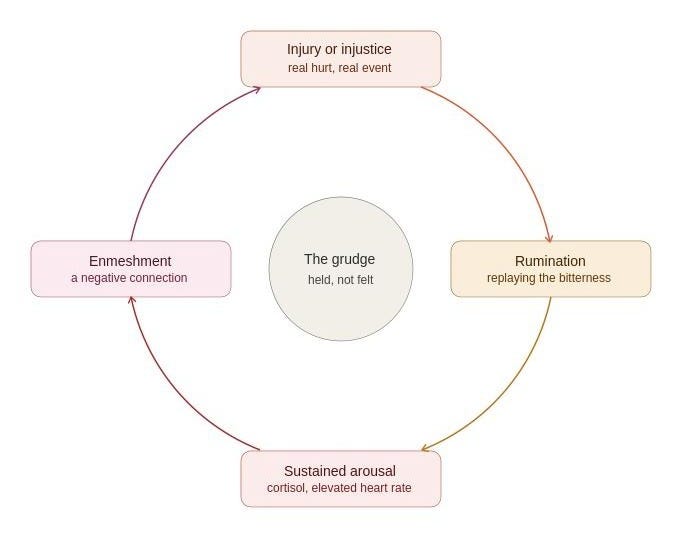
Each stage reinforces the next
As examples, if it’s a father or a man or a male figure, it locks us into a closed-loop thinking about men, generalizing all men, or all the male lineage, or that all men are potentially the same way, or it gets us stuck linking it all to patriarchy, colonialism, white supremacy, etc.
You can replace men with any race, gender, class, age, culture, religion, political side, education, and so on.
I don’t want to minimize the hurt that precedes resentment. Abuse is real, be it sexual, emotional, or physical. Power dynamics are real. People of color, especially Black bodies, experience a lot more abuse than white-presenting bodies. This racial bias is real and also produces outcomes that are ancestrally passed on.
Even though all that is true and painful, I have seen no research and have found no advantages in keeping resentment alive way past the events that caused it.
Again, many of these abusive behaviors are ongoing, chronic, and perhaps even constantly escalating.
Race dynamics, class disparities, immigration rights, reproductive rights, gender injustices, and sexual abuse towards women and children are chronic symptoms of dysfunctional human behavior patterns, much more common in males, constantly occurring and perhaps never diminishing in an individuals life, so the chances of resentment dissipating can be low.
Outcomes of Unacknowledged and Unprocessed Resentment
What I am most concerned about is the physiological, emotional, mental, and even energetic and spiritual repercussions for you, as the resentful person.
I have thought a bit about the evolutionary purpose of such a complex and disturbing pattern of the brain. It seems to me the entire purpose of resentment is in keeping the person somehow “safer” by locking them into ruminating constantly about how bad their subject of resentment is, and how much disgust and frustration they produce in them, in order to create the close-loop thinking which eventually leads either to implicit bias, phobia, or both.
I think there are some very real advantages to tracking resentment as a preventative measure against future encounters with unpleasant or “bad” subjects. That evolutionary goal of resentment is wonderful if it comes with the skill to reflect on the topic, in order to feel the outrage, the disgust, the anger and frustration, with the main goal of processing and integrating the bad experience, preventing future similar encounters, and avoiding the subject altogether as much as possible.
Without observing and having time to process the effects this subject has had on us, it is nearly impossible to detect the resentment closed-loop and to decide when it is a healthy pattern and when it isn’t.
This is where things get messy on a deeper level. It might be an appropriate evolutionary pattern, but maybe it’s not useful or healthy to share it anywhere with everybody, or to hold it for a long time.
There are times and places that are good for this processing to be shared and integrated, and places where this can only escalate into a fight, more explosion or further disparity, leaving the subject of the resentment, feeling like the victim, instead of the perpetrator. Nobody learns when they feel like a victim. Receptivity is a crucial component of behavior correction.
I was so resentful towards my father that we never could have a conversation about what he did, so we never had repair, and he died not having a clue of how hurtful he was. I wondered later in life if my deep resentment was in part responsible, at least energetically, for him dying so early. With a bit of remorse, knowing I didn’t know any better, I can say confidently that my resentment fueled, in part, his illness. The stress from my resentment whenever we interacted, was probably super distressing for him, but we never talked about it.
Unacknowledged, unintegrated, and unconscious resentment is like a volcano ready to erupt, but also constantly forming and slowly spreading new lava in the landscape surrounding the crater. Remember the movie Frozen where Elsa’s resentment spreads as the entire land that surrounds the castle becomes ice?
Reminds me as well of Game of Thrones and the winter that came and never left, bringing with it all the flesh-eating zombies. Resentment is that winter, and our minds become the zombies.
Unacknowledged and unprocessed resentment can have terrible health and mental repercussions and can also lead to chronic isolation and grudge-holding, sustained anxiety, and rigid patterns of mistrust and a diminishing capacity for connection. It can also lead to mental distortions, closed-loop thinking, implicit bias, hyper vigilance, mind-reading, and assuming ill intent, even from the nicest people.
On a more energetic and body-oriented level, clients have described resentment like a burning sensation in the entire midline of the body from the chest to the pelvis. Depending on how long they have been carrying, holding, and feeding the grudge, they describe the burning sensation as ranging from a mild fiery feeling to black burned coals.
The absence of resentment does not guarantee forgiveness or resolution of the conflict. It does not imply that the subject of the grudge is now free to reenact their hurtful behavior. Absence of resentment is personal work, and it doesn’t change others’ behaviors or intentions.
Resentment prevents the integration of shock because we focus all our attention on the perpetrator, making it impossible to feel what lies beneath the grudge. The grudge replaces all other feelings.
Enmeshment and Resentment
Without knowing, we also get enmeshed with the subject of our resentment. This has been the most challenging for clients to understand. A negative bond is still a bond. Part of us won’t release the subject of our grudge, so we hold them hostage in our minds. This keeps us enmeshed with them so we don’t forget what happened.
Five questions to ponder
To simplify it, pick just one resentment per answer
Why are you still holding onto this resentment?
What are the benefits of holding this grudge?
What would happen if you let go of the resentment?
Who would you be without resenting them?
Who would they be if you did not resent them?
How I stopped resenting my father and other perpetrators (personal and collective ones)
Follow the next post for this answer and subscribe to get this writing in your email.
*
Thanks for making it this far! You love deep and long writing form, like me!
*
If interested, please support this letter by joining the paid tier. I will be creating more material and courses through here, and your support means the world.
Thanks for reading and please share it with others if it was useful.
Tough love right here 😜